Showing posts with label Tools. Show all posts

Google Street View explores Japan disaster zone


Google Street View explores Japan disaster zone - Google has published a bank of interactive images of the area of Japan hit by a huge quake and tsunami in March, letting viewers take a virtual walk through the zone before and after the disasters.

Vehicles from Google's Street View service drove along 44,000 kilometres (27,000 miles) of roads to collect the images from the areas worst affected by the twin disasters, which killed about 20,000 people.

Mostly shot in July, the 360-degree images linked to a map of the area provide a portrait of devastation, with piles of debris, gutted and flattened buildings, and overturned boats amid a vast wasteland.

Google Street View explores Japan disaster zone
Google has published a bank of interactive images of the area of Japan hit by a huge quake and tsunami in March


At users' request, Google also provides images of the same region before the quake, with a comparison tool for "before" and "after" pictures. The photos capture 82 cities and villages in the prefectures of Miyagi, Iwate, Fukushima, Ibaraki, Yamagata and Aomori.

"It is our hope that this will help people rediscover lost memories of their homes and towns," said Google on the dedicated site, which will also host photos and videos uploaded by residents from the area. ( indiatimes.com )

The site can be accessed in English at www.miraikioku.com/streetview/en

READ MORE - Google Street View explores Japan disaster zone

Ways to heal your snoring partner


Ways to heal your snoring partner - Many people tend to lose their sleep because of their other half's consistent snoring but simple changes in the lifestyle can potentially help them get rid of this quandary, a new study has suggested.

There are several risks linked to the snorer's health, too, like high blood pressure, diabetes and even stroke.

"In the majority of cases, simple lifestyle changes can have a big impact," the Daily Mail quoted Myles Black, an ENT surgeon at East Kent Hospitals University NHS Foundation Trust as saying.

Different types of snoring require different ways to tackle them, like for nasal snorers, breathing right nasal dilator strips - special plasters you put on the outside of the nose which stretch the nostrils open - can provide extra external support to improve airflow.


Ways to heal your snoring partner
Partner’s snoring keeping you up at night? Here’s what you can do (Thinkstock photos/Getty Images)


"In extreme cases we can perform surgery to insert small rods, or silver rings, which keep the airways open."

"Using a mattress cover and man-made fibres for duvets and pillows can eliminate dust and house mites, a common cause of nasal congestion, and using nasal steroid sprays for a minimum of two months can help."

For people who are prone to tongue snoring, if their tongue is falling too far back, a bespoke mandibular advancement device (MAD) has been shown to be effective in a majority of users.

This is in effect a plastic mouth guard that pulls the lower jaw and in turn, the tongue forward to open the airways.

A low-tech solution to prevent the tongue falling into the back of the throat is sewing a tennis ball into the back of your pyjamas.

'This simply prevents you sleeping on your back,' he said.

Losing weight and avoiding night-caps and smoking (which irritates the throat and nasal linings) are also important.

Mouth snoring can be prevented by maintaining a healthy body mass index, limiting alcohol intake and stopping smoking. These tighten the neck muscles and pull up any soft tissue responsible for the noisy vibrations.

"The surgical solution I advocate in this situation is pillar implants that support the palate," said Douglas Keay, an Ear Nose and Throat (ENT) surgeon.

These plastic rods are inserted into the soft, floppy part of the palate in a 15-minute procedure.

Obstructive sleep apnoea, which occurs as a result of narrowing of the airways can also cause snoring.

"One of the most effective therapies is continuous positive airway pressure (CPAP), a mask worn at night where air is pumped continuously to keep the airways open," said Mr Al-Ayoubi. ( indiatimes.com )

READ MORE - Ways to heal your snoring partner

Facebook Continues to Fend Off Scammers Fraudulent Web Sites Top List of Hottest Google Search Terms


Facebook Continues to Fend Off Scammers. Fraudulent Web Sites Top List of Hottest Google Search Terms. On Wednesday, users of the popular social networking site were attacked by yet another phishing virus attempting to harvest their e-mail addresses and passwords.

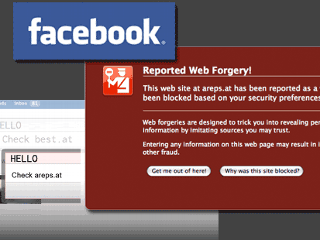
Prompted by a Facebook message sent from a friend's account, users are sent to "areps.at," "best.at," "brunga.at" and "kirgo.at" -- Web sites constructed to mirror Facebook's log-in page. Thinking they're on a Facebook-related site, users enter their e-mail addresses and passwords.


Facebook scams
Phishing scams that attempt to harvest users' personal information continue to plague social networking site Facebook. (ABC News Photo Illustration)


But once the menacing program has this information, it perpetuates the scam by hacking into users' accounts and re-sending the link to their friends in a message simply labeled "Hello" that contains the link. In late April, two similar viruses, FBAction.net and FBStarter.net, attacked Facebook.

'Brunga.at' and 'Areps.at' Are Two of the Fraudulent URLs

Although it's difficult to assess how many accounts have been infected by the virus and Facebook declined to disclose the information, as of Thursday evening, "brunga.at" and "areps.at" topped the list of hottest Google search terms.

"The impact of this attack or the previous ones are not widespread and only impacted a tiny fraction of a percent of users," Facebook spokesman Barry Schnitt told ABCNews.com in an e-mail. "We've been updating our monitoring systems with information gleaned from the previous attacks so that each new attack is detected more quickly. Our technical efforts and user education initiatives are significantly reducing the impact of each subsequent attack."

He said the social networking site had blocked links to the questionable sites from being shared on Facebook and had added them to the list of sites blacklisted by major browsers. The company also is cleaning up phony messages and wall posts and resetting the passwords of affected users.

Although the motivations of the people behind the attack are unknown, Facebook is an appealing target for spammers because users store so much personal information on it. In addition to names and e-mail addresses, some people keep their birthdays, addresses and telephone numbers. Once hackers have that information, they can sell it to others on a black market.

Users should be cautious of Facebook messages that look suspicious or require an additional login. Those who have entered their information on these fraudulent sites should change their passwords. Facebook also encourages members to visit its Facebook Security Page for updates on new threats.

Phishing Viruses Thrive Off the Fact That People Trust Their Friends

Justin Smith, editor of InsideFacebook.com, said it's difficult to know how many people are infected by attacks like this. But in the past, he added, Facebook has said about 1 percent of users' are affected by spam attacks. That's a small percentage, to be sure, but still a significant chunk of people when you consider that the site has more than 200 million users.

Facebook, he said, invests significant time and resources in fighting hackers but it can only do so much.

"Attacks like these do illustrate one type of social networking security challenge that's likely to persist: They thrive off the fact that many people will always click on links in messages from friends, even if they seem out of the ordinary," he said.

This scam, like the others, steals passwords to propagate itself, he said. But it doesn't appear to abuse the compromised accounts any further than that.

Nick O'Neil, editor of the blog AllFacebook.com, said these false Web sites, like their predecessors, appear to originate from Eastern Europe.

In recent weeks, he said, at least one visible phishing scam has hit the social networking site each week.

"Facebook has been in a full-fledged war with spammers and hackers, and this is only the latest round of that battle. Over the coming weeks and months, you can pretty much guarantee that we'll see more of them," he wrote, adding that these scams are not as vicious as the ones that notoriously plagued MySpace years ago.

New Users Are Like 'New Kids on the Block'

Smith also said that as Facebook welcomes scores of new users, about 3.5 million each week, it creates a large audience of people who haven't been exposed to the kinds of phishing attacks that hit social networking sites.

"I think we've seen as new users have joined, it takes some time for users to figure out how to use new communication tools," he said, adding that many new users are over 35 and new to this kind of social environment.

"These are kind of the new kids on the block, and so it's a little easier to pick on them," he said.

Facebook's Schnitt, however, has maintained that they have not established any correlation between new users and the attacks.

He also cautioned users to only log in to sites when www.facebook.com is in the browser and to be very cautious of any messages or links they find on Facebook that ask them to log in again. Keeping unique logins and passwords for different sites is also helpful. ( ABCNews )


READ MORE - Facebook Continues to Fend Off Scammers Fraudulent Web Sites Top List of Hottest Google Search Terms

Surgery Breakthrough Stretches Girl's Arm


Surgery Breakthrough Stretches Girl's Arm. Bone-Lengthening Makes 9-Year-Old Girl's Dreams Come True. A pioneering new surgery technique is a dream come true for a 9-year-old Arkansas girl with a rare bone disease.

Lauren McCabe was born with a left arm nearly two inches shorter than her right, a condition that has kept her from being able to lead a normal life.

"I can't really ride bikes, I can't really bowl and I can't swim with my arm like that," explained Lauren. Her disease has also had an effect on her self-confidence, like the time she entered her local Miss Strawberry Pageant.

"One time in the Strawberry, I actually had my arm in front so I put it behind my back so nobody could ever notice it."


arm surgery
(ABC News)

Stretching Surgery

Her disability and disfigurement was getting progressively worse every year. "The condition is a condition where instead of growing long and straight, the bones grow bent and short and branches," explained Dr. Aronson, chief of pediatrics at Arkansas Children's Hospital, who is one of the pioneers of the bone surgery that Lauren had.

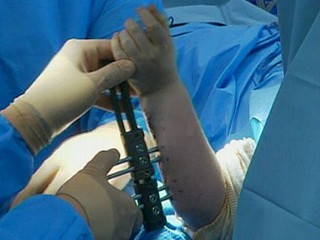
"What we're doing is a bone lengthening, which means that we have to gently crack a bone so that its blood supply is preserved, stabilize the bone with pins that connect to the outside, a frame, and through that frame we stretch the bone very slowly," said Dr. Aronson. At two and a half hours, the surgery is relatively quick.

The actual process of lengthening the bone though takes months. While Lauren healed, doctors stretched the bone one millimeter a day with a motorized device. As they slowly separate the bone and pull it apart, new bone grows to close the gab, thus lengthening the limb. It's painstakingly slow so it doesn't hurt.

Bright Future

After about five months doctors removed the device and fitted Lauren for a cast. "Good Morning America" met Lauren at the hospital on the special day the cast came off and found her full of excitement for the future.

Before long she was chatting about the confidence she'd have cheerleading. "I'll hold it. I'm gonna wave and everything," says Lauren.

Dr. Aronson says he's happy just knowing there'll be no more physical obstacles in her life. "Her function is most important to me, and that's something a child can't always realize. But it all works together to make a dream for someone, and that's what we try to do." ( abcnews.go.com )


READ MORE - Surgery Breakthrough Stretches Girl's Arm

Some Lip Gloss May Promote Cancer


Some Lip Gloss May Promote Cancer. There's No Proof Yet But Beware Gloss With No SPF. Spring is here, legs have been reacquainted with the razor and women are buying lots of shimmery lip gloss on impulse.

But have you heard the buzz that cheap, fun, non-SPF gloss can possibly increase your skin cancer risk?

Here's the theory:

Some dermatologists have said that the translucent sheen helps ultraviolet rays penetrate the already fragile skin of the lips -- thereby increasing your risk. These dermatologists may be on to something, according to some of the top experts in the field.

Dr. Jessica Fewkes, a face and neck skin cancer specialist at Harvard, draws a cautious analogy between wearing non-SPF (sun protection factor) lip gloss in the sun and using baby oil to promote tanning. "You might be able to infer that they both enhance UV exposure," she says.

Dr. Kevin Cooper, chairman of the dermatology department at Case Western Reserve in Cleveland, explains that any increased penetration of ultraviolet rays would be due to "enhanced optical passage" of the dangerous rays. But the increase, he qualifies, would be small.

Here's the catch:

There are no large, targeted studies proving or disproving this theory, which makes Fewkes, Cooper and the American Cancer Society reluctant to draw fixed conclusions.

Dr. Len Lichtenfeld, the society's deputy chief medical officer, says that it seems "like just a theory."

"It's OK," he adds, " to have theories about how diseases are caused or influenced, but we have to see evidence. There should be an effort made to do large, population-based studies."

And, in the absence of such studies, it's hard to get a simple yes or no from a doctor.

Nevertheless, specialists agree that just as it's universally recommended that people wear at least SPF 15 on their faces, it makes sense to do the same for the lips. And in these UV-ray conscious times, it's not hard to find gooey pink gloss that comes with protection.

And consider this:

According to Cooper, squamous cell carcinoma (the kind of cancer that makes up 90 percent of new cases of lip skin cancer each year) has a higher risk of metastasis on the lips. That means that it's more likely to aggressively spread if it starts on your lips than if the same kind of cancer appears first on other parts of the skin.

Bonus:

If you really need another reason to make sure your gloss is SPF 15, think about the prematurely wrinkle-mouthed look you probably want to avoid. Fewkes says that if gloss does, in fact, increase lips vulnerability to UV rays, it stands to reason that it promotes photoaging as well.

"The damage done short of a true cancer can be very difficult to treat," she says, referring not only to painful fissures, but to solar keratosis -- nonmalignant yet unpleasant crusty bumps. ( abcnews.go.com )


READ MORE - Some Lip Gloss May Promote Cancer

When Not Fatal, Lightning Leaves Significant Physical And Mental Scars.


When Not Fatal, Lightning Leaves Significant Physical And Mental Scars. Lightning Carries Significant Health Hazards, Assuming Victim Survives. After Tuesday's lightning strike, 12-year-old Chelal Matos' death in Virginia's Spotsylvania County brought the tally of lightning-related fatalities to six this year, including a woman who was killed by an indirect lightning strike in California last month.


The health effects of getting struck by lightning.

People struck by bolts of lightning, which can carry millions of volts of electricity, can suffer significant physical and mental damage.
(Curtis Martin/Getty Images)

Lightning is second only to floods as the deadliest natural threat, claiming about 58 lives each year, according to data from the National Weather Service. Yet the awesome electrical power of a lightning bolt, whether it hits a person directly or indirectly, can leave significant, lasting physical and mental damage, including burns, vision loss and personality changes.

"Lightning is a much larger problem than most people think," said Dr. Jonathan Adler, an attending physician in the Department of Emergency Medicine at Massachusetts General Hospital.

According to John Jensenius, a lightning safety expert at the National Oceanic and Atmospheric Administration, the average lightning bolt carries 20,000 to 30,000 amperes of charge and about 300 million volts.

A direct hit occurs when all of the lightning's energy is directed through the body or over the body on the skin. Although Adler said these kinds of strikes account for only 4 percent of all reported strikes, they are the most dangerous.

"When people are struck, current travels around the body, and sometimes people do surprisingly well, or through the body, which is a more severe injury and very broad," Adler said.

Lightning Can Shut Down Body Functions

An intense shock can severely impair most of the body's vital functions. Cardiac arrest is common.

"Commonly, when there is a strike that affects the heart directly, there is a massive shutdown," Adler said. "With every beat the heart depolarizes and changes its electrical signal. The heart flat-lines ... and stays that way for some time."

In addition, Adler pointed out that the shock can temporarily paralyze the diaphragm and knock out circuits in the brain that instructs the body to breathe.

"If a person gets CPR right away they have a better chance of survival," Adler said.

Post-Lightning First Aid Is Crucial

But CPR must continue for a long time because it takes a long time for the heart to beat again, the diaphragm to function, and even longer for the brain to reboot and control vital organ functions. People who go into cardiac arrest have a 75 percent mortality rate.

Chelal received CPR from two nurses who were on the scene, according to First Sgt. Liz Scott of the Spotsylvania County Sheriff's Office, but he did not survive. A second boy who was walking close to Chelal when he was struck was also injured from the bolt, possibly through a secondary encounter.

Chelal's friend is still in critical condition, Scott said.

Secondary Exposure Can Be Deadly, Too

While direct hits are dangerous, secondary encounters are more common but can be just as perilous. Ground currents, which occur when lightning strikes an object or the ground and the electricity travels through the ground until it encounters another object, such as a person, make up about 50 percent of lightning injuries.

Another common way to be struck is through a side flash, or a splash, when lightning that has struck an object seeks a path that lets it jump through the air to a second object.

Whatever the variety, there are long-term consequences for survivors of lightning strikes. People can develop problems days, weeks or months after the event.

Adler said survivors and their families should watch for changes in personality or areas of mental function. Survivors often lose their ability to concentrate on tasks such as reading for long periods of time, finding it uncomfortable. Some people find they have poorer mathematical skills.

"It's like a traumatic brain injury where people are not OK in some way," Adler said.

Because currents often flow into the body through the eyes and ears, patients may also experience vision loss, cataracts and hearing loss.

The most fortunate people are those for whom the lightning travels over the skin rather than through the body, leaving them with damage, but largely in the form of burns.

Precaution Is Key for Lightning Safety

There is no way to predict how a bolt of lightning will behave for any particular person, based on age or height or medical condition. But people who spend significant amounts of time outside, particularly in areas where there is a lot of lightning activity, are most at risk.

Texas receives more lightning strikes each year than any other state, about 1.9 million, with Florida in second place with about 1.3 million strikes.

Such accidents can often be avoided by attending to weather warnings and practicing proper lightning safety, Jensenius of the National Oceanic and Atmospheric Administration said.

"It's a question of being in the wrong place at the wrong time," Jensenius said. "There is no place that is safe outside. ... An awful lot of energy moves along the ground when lightning strikes."

Lightning Lore

Common misconceptions can impede lightning safety practices. For instance, metal objects do not attract lightning any more than other objects. Height is the determining factor in where it will strike. A taller object makes it easier for electricity to trace a path to earth from high in the clouds.

The safest place to go at the first rumbles of thunder, which signal striking range, is in a substantial building or a car.

"Many of the people involved [in lightning accidents] were involved in normal recreational, day-to-day activities," Jensenius said. "If they had taken shelter sooner, they would have been safe."

Still, Jensenius said the average number of lightning-related fatalities each year is decreasing because people are more proactive about lightning safety. As recently as last year, the average yearly fatalities were about 62 people. During the early part of the 1900s, that number was as high as 400 fatalities per year.

"The key to reducing fatalities is really in planning ahead," Jensenius said. "If they hear thunder, they are within striking distance of a storm. ... And stay inside after the thunder has died for 30 minutes afterwards." ( abcnews.go.com )


READ MORE - When Not Fatal, Lightning Leaves Significant Physical And Mental Scars.